Outsourced Takeoff Services for Contractors
Two ways to order the same measurement work: quantities broken out by trade for a bid you price yourself, or one consolidated buy list for a job you are buying out. Both are measured straight off your drawing set, checked twice, and delivered 24-96 hours from an approved fixed quote.
What ships with every package
- Editable Excel or CSV, unlocked and ready to price
- Color-coded marked-up PDFs of the sheets measured
- Written assumptions, inclusions and exclusions sheet
- Estimator self-check, then an independent second-estimator audit
- Revisions included on unchanged scope
Should you outsource takeoffs at all?
Outsourced takeoff services for contractors are worth it at a specific point in a bid week, and not before it. Here is where that line sits.
Should you outsource your takeoffs?
Outsource when measuring is the thing stopping you from bidding more. A mid-size drawing set eats a night or two out of somebody's week, and that somebody is usually the person who should be walking jobs and answering GCs. Sending the measurement out turns fixed payroll into a per-bid cost you carry only in the weeks you bid.
What does an outsourced takeoff service hand you?
An editable Excel or CSV workbook of measured quantities, color-coded PDF markups of the sheets those quantities came off, and a written assumptions, inclusions and exclusions sheet. Every figure traces back to a labeled markup, so your estimator can audit the package rather than trust it.
How much of your bid week does this give back?
You get the hours back on a date you can plan around. Delivery runs 24-96 hours from an approved quote and is scheduled against your bid date, not against whenever a takeoff happens to finish. What you do with that week is the whole point.
Do you have to send the whole drawing set?
No. Name the trades you want covered and the quote is scoped to exactly those. A framing sub sends the architectural and structural sheets. A GC checking one number sends one division. Nobody pays to measure scope they already have covered in house.
Which takeoff does your job need?
Same drawings, two different outputs. Order the one that matches where the job sits: still being bid, or already won and being bought out.
What outsourced takeoff services actually fix
Three things quietly cost contractors money every bid cycle. Here is what each one costs, and what an outside desk does about it.
Bids you never submitted
Every invitation you decline because nobody is free to measure it is a job awarded to somebody else. A shop that caps its bid volume at what one desk can measure has capped its revenue at the same number.
Tired eyes at 11pm
A missed schedule mark, a wall type averaged instead of counted, a finish level read off the wrong sheet. None of it surfaces until buyout, and by then the number is submitted and the margin is spent.
A desk that costs the same whether you bid or not
A salaried estimator costs the same in a quiet month as in a bid-heavy one, and you carry the seat through both. An outside desk turns that fixed line into a variable one.
CSI 01-49, and the unit each division ships in
One trade or every trade on the set. This is the index and the unit each package lands in. The trade by trade measurement detail lives on the two pages this one feeds.
| CSI 01-02 | General requirements and existing conditions | LS, EA, SF |
|---|---|---|
| CSI 03-04 | Concrete and masonry | CY, SF, TON, EA |
| CSI 05 | Metals | LF, TON, EA |
| CSI 06 | Wood, framing and composites | EA, LF, SF, BF |
| CSI 07 | Thermal and moisture protection | SF, LF, SQ |
| CSI 08 | Openings | EA, SF, LF |
| CSI 09 | Interiors and finishes | SF, LF, GAL |
| CSI 10-12 | Specialties, equipment and furnishings | EA, SF, LS |
| CSI 13-14 | Special construction and conveying | EA, LS, SF |
| CSI 21-28 | Mechanical, electrical and plumbing | LF, EA, LB |
| CSI 31-33 | Sitework, utilities and paving | CY, SF, SY, TON |
| CSI 40-49 | Process and material handling | EA, LF, LS |
Send one drawing set and see the package first
Name the trades and your bid date. An estimator scopes it and sends back one fixed price in writing. Nothing is billed until you approve it.
Who actually opens your drawing set
You are about to send plans to people you have not met. Here is who picks the job up, how it gets assigned, and what happens when you want to argue with a figure.
Who gets my set?
An estimator who works that trade. A masonry package does not go to whoever is free, and an electrical package does not go to the person who measured your slab. The software follows the same rule: conduit, gear and device counts on the electrical platforms, flooring on the flooring platforms, cut and fill on the earthwork platform. The tool is picked for the scope, not for the office.
Do I talk to that person, or to a support queue?
To that person. Scope questions, a walk through the assumptions sheet and revisions all go to the estimator who did the work rather than to somebody relaying it. On a monthly partnership or a dedicated estimator it is the same person job after job, so by the fortieth package they already know how you carry general conditions and which sheets your bid form cares about.
What sits behind the two numbers on this page?
7,500+ projects measured for 1,600+ contractors, across all 50 states and CSI 01-49. That record is where the production rates, the trade coverage and the assumptions library come from. It is also why a trade you think is unusual has almost always been measured here before, and why a coverage question gets a reply inside 30 minutes during the working day.
What happens when I think a figure is wrong?
Point at the line. Every line names its markup and the sheet it was read from, so the geometry opens in seconds and the disagreement becomes a specific one instead of an argument about a total. If it is our error we rerun it. Arguing with a quantity is free on unchanged scope, which is the point of shipping the markups with the workbook.
When outsourcing takeoffs is the wrong call
There are jobs where sending the measurement out costs you more than doing it yourself. Here they are, before you spend anything.
A takeoff is only as good as the set it comes off. A napkin sketch, a marketing rendering or a site walk you did in your head is not a set. Order the measurement once you have numbered sheets, a stated scale and enough schedules to resolve the conditions. Before that, what you need is a conceptual budget, which is a different job on a different desk.
A single-room remodel or a two-page service order is faster to measure than to brief out, and paying anybody to do it, us included, is not a saving.
And skip it if what you want is somebody to own the bid decision. We measure, and on the estimating desk we price. We do not choose your markup, we do not pick which invitations you chase, and we do not put a number in front of a GC with your name on it. If that is the help you want, takeoff services are the wrong tool for it.
What cheap takeoff work does to a bid, and how each failure is stopped
Contractors burned by an outside measurement were usually burned in one of five ways. Each has a specific cause and a specific control that runs on every package.
Failures in the measurement itself
The quantity is wrong before anybody prices it.
Scale taken on faith
A sheet printed to fit, rotated or rescanned reads short, and every quantity off it reads short with it. The drawing still looks normal.
Scale verified against a known dimension
Each sheet is checked against a dimension the drawing itself states before any measurement is taken. A set that will not verify comes back as a flag, not as a number measured through the problem.
Conditions averaged instead of counted
One wall type applied across a floor, one door treated like every other door, one finish level spread across a building. Fast, and always wrong somewhere expensive.
Measured by type, never by gross area
Wall types, door marks, finish levels and assemblies stay separated into the workbook, so a rated assembly never averages into a non-rated one and a heavy hardware set never disappears into a count of openings.
Sheets read in isolation
The plan says one thing, the schedule says another, the detail says a third, and whoever measured only opened the plan.
Plan, schedule and detail reconciled before release
Counts come off the plan and are reconciled against the schedules and the details. Anything that will not reconcile is written down and sent to you, not quietly resolved in your favor or against it.
Failures in what gets delivered
The quantity may be right and the package still unusable.
A locked file nobody can audit
A flat PDF of totals, or a spreadsheet with the formulas stripped, forces your estimator to retype the work before checking any of it. At that point you have paid twice.
An editable workbook plus the markups behind it
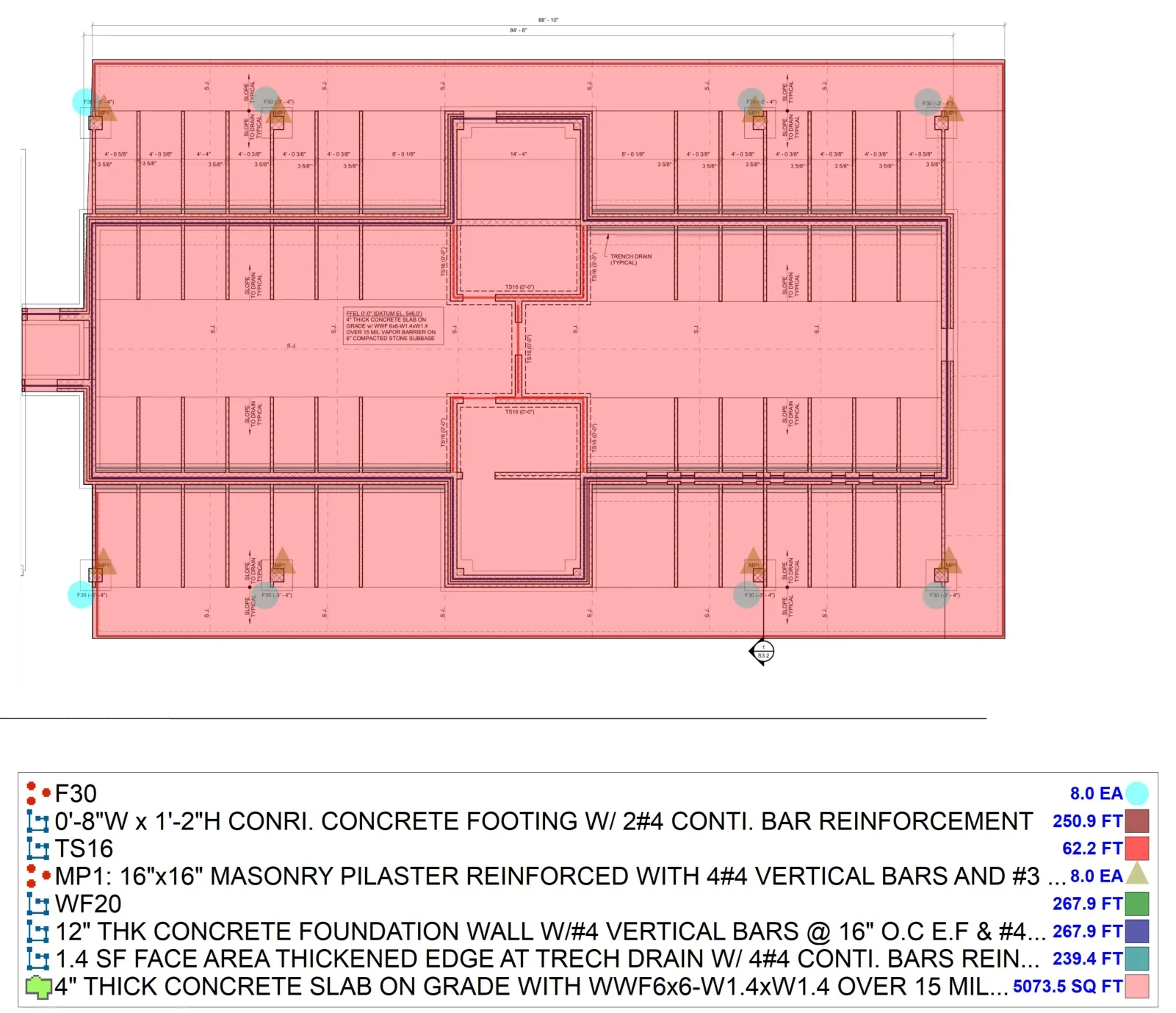
Excel or CSV with live columns, units and totals, delivered next to the color-coded markups every figure was measured from. Source takeoff files are available on request.
Silence about what was left out
An exclusion nobody wrote down becomes a scope argument at buyout, and the contractor loses it because the package never said either way.
Assumptions, inclusions and exclusions in writing
One sheet, delivered with the file, stating what was counted, what was assumed and what was deliberately left out. Written before delivery, not reconstructed after a dispute.
Ask an estimator before you upload anything
Coverage on an unusual trade, units, a set that is still being reissued. Ask the estimator who would measure it, and expect an answer inside 30 minutes of the working day.
What the first engagement actually looks like
No portal to learn, no account to create, no minimum order. Here is the whole sequence in order, with the real timings attached.
Upload the drawing set
Scope review and a fixed quote
Measurement by a trade-appropriate estimator
The two-step check
Delivery, then addenda
How scope is controlled when the set is not final
Almost no set arrives complete. Here is what happens when yours is missing sheets, contradicting itself, or still moving under you.
What happens when a sheet is missing?
The condition is measured to the boundary of what the set actually shows, and the gap is written onto the assumptions sheet with the sheet number it belongs to. You get a quantity plus a named hole, instead of a total with a guess folded invisibly into it. Send the missing sheet and that line gets replaced.
What happens when two sheets disagree?
The conflict is flagged, not resolved silently. Plan, schedule and detail are reconciled where they can be, and where they cannot, both readings and the quantity impact of each go to you before delivery. You decide which one the bid carries, because that decision is commercial and it belongs to you.
The set is still being reissued. Do we wait?
No. Order against the issue in your hands and name the issue date at upload. It goes on the assumptions sheet, so when the next issue lands only the conditions it touches get reopened. Waiting for a final set is how a bid date arrives with nothing measured.
What if the specifications and the drawings do not match?
Drawings govern the quantity, specifications govern the assembly. Where a spec calls for something the drawings never show, it is listed as an inclusion or an exclusion in writing rather than counted into a number nobody can trace. Send the spec book and far fewer of these come up.
Want the quantities priced or drawn instead?
Measuring is half of it. Whether the next step is pricing those quantities, detailing the steel behind them or running the whole bid, it comes off the same measurement pass, so takeoff estimating services stay one job with one scope conversation.
A bid-ready total, not a count
Labor, material, equipment, burden, overhead and profit applied to the measured quantities, priced against the market the job gets built in rather than one national average.
See construction estimating servicesCarrier scopes on their own ruleset
Mitigation and rebuild scopes price by a carrier ruleset rather than a CSI build-up, so they run on the Xactimate desk. Order one alone or alongside a full rebuild estimate.
Xactimate insurance estimatesWage determinations, not market rates
If your job carries a wage determination, the labor line is built from classifications and fringe rather than local market rates. Say so at upload and it is priced that way from the first line.
Prevailing wage estimating servicesFrom member list to shop drawings
Once the steel is measured, the fabricator needs it drawn: shop drawings, erection and anchor bolt plans, and an advance bill of material to release the mill order against.
Structural steel detailing servicesOutsourcing more than the measuring
Lead sourcing, invitation tracking, proposal assembly and submission, run alongside the measurement and the estimate rather than bolted on after both.
Outsourced bid management servicesRun three or more bids a month on a retainer
The monthly partnership runs a priority queue with unlimited revisions and addenda included. Tell us how many jobs a month you bid and we size it.
Files you can work in, not files you have to retype
A takeoff your own estimator cannot open, edit or audit is worth less than no takeoff at all. Everything ships open.
The package
Three files, every time, on a one-trade job and on a full set.
Editable Excel or CSV
THE WORKING FILEA professional takeoff service should hand back files your own estimator can open, check and change without asking anyone's permission. That is the standard every package here is built to.
Unlocked, not a locked export
Columns, units and totals stay live and editable. Drop your own rates into the pricing column, resort by trade, or paste the sheet straight into your bid form. No password, no read-only export, no retyping.
Your template or ours
If your team bids off a specific spreadsheet layout, or codes to its own CSI structure, send the template with the drawings and the package comes back in it.
Color-coded marked-up drawings
THE PROOFEvery quantity is tied to a labeled markup on the sheet it was measured from, color-coded by trade.
Auditable in seconds, not hours
Pull any single number out of the workbook and you can find the exact wall, run or footing behind it. That is what makes a second opinion cheap instead of a rebuild.
Written assumptions, inclusions and exclusions
THE SCOPE RECORDWhat was counted, what was assumed, and what was deliberately left out, on one page beside the workbook. It is the sheet that settles the argument at buyout instead of starting one.
Tools and source files
Measured in the software the trade actually uses.
Primary measurement platforms
COREMeasurement is done in PlanSwift, Bluebeam and Xactimate, the platforms your own estimators and the carriers you deal with already read.
Trade-specific platforms
BY TRADEOn-Screen Takeoff, Accubid, McCormick, ConEst, Measure Square, RFMS Measure and Kubla Cubed are used where the trade calls for them.
The tool follows the trade
Conduit, gear and device counts on Accubid, McCormick or ConEst. Flooring on Measure Square or RFMS Measure. Cut and fill on Kubla Cubed. The platform is chosen for the scope.
Source files on request
ON ASKWhatever a package was authored in, the source takeoff file is available on request, so your estimator can open the work rather than take it on faith.
See a delivered package first
FreeA delivered package with the project details stripped out: the workbook, the marked-up sheets, the assumptions page. Pick a figure at random and see how long it takes you to find the wall it was measured off. If that takes more than a few seconds, the package failed.
See sample deliverablesYour drawings, your numbers, your margin
Outsourcing the measuring should not mean handing over control of the bid. Here is the line, and it does not move.
Three ways to run takeoff services with us
Per bid, monthly, or a dedicated estimator. Same output and the same two-step check on all three. What changes is the commitment, and the saving grows with volume.
| Best for | A first job with us, or a shop that bids occasionally | Shops running three or more bids in a month | Volume that justifies a person but not a hire |
|---|---|---|---|
| Commitment | None, one job at a time | Flat monthly retainer | One estimator assigned to your work |
| Delivery | 24-96h, scheduled to your bid date | 24-96h priority queue | 8 hours a day, 5 days a week on your cadence |
| Revisions | Included on unchanged scope | Unlimited, addenda included | Included on unchanged scope |
| Quality check | Two-step QA | Two-step QA | Two-step QA, same estimator every job |
| Typical saving | ~25-35% against in-house | ~40-55% against in-house | ~35-45% against the loaded seat |
Before you send the drawings
The questions contractors ask right before they upload a set.
Scope and coverage
Files and privacy
Pricing and quotes
Accuracy and checking
Revisions and changes
Send the drawing set and get a
fixed quote
Name the trades, name your bid date, and attach the set. An estimator scopes it, prices it in writing, and nothing is billed until you approve that number.