✉ Email plans to kb@takeoffservicesllc.net for a quick quote, or upload through the form belowReplies within 30 minutesEstimating desks covering all 50 states
TS
Takeoff Services LLC
Where Bidders Win
BUYOUT AND PROCUREMENT

Material Takeoff Services Built For Buyout

One consolidated buy list in the units your suppliers sell in, with waste allowed for in a column you can see, so three vendors quote the same sheet line for line.

24-96h from an approved quote Purchase units, waste stated CSI 01-49, all 50 states
PDF or ZIP up to 25 MB, or a Drive, Dropbox or OneDrive link for a set of any size. Nothing is billed until you approve a fixed quote in writing. NDA signed on request.

What ships with every buy list

  • One row per purchasable item, not one per drawing
  • Net quantity, waste factor and gross quantity in separate columns
  • An empty vendor pricing column, ready for three quotes
  • Color-coded marked-up PDFs tying every row to the plan
  • Written assumptions, inclusions and exclusions
  • Long-lead items flagged in their own column
Editable Excel and CSV. Nothing locked, nothing flattened.
24-96h
Delivery from approval
7,500+
Projects taken off
1,600+
Contractors served
CSI 01-49
Divisions covered
50
States covered
PLAIN DEFINITION

What a buy list is, and what is on it

A material takeoff is the procurement view of your drawings. It is the output you order once the bid is behind you and the job has to be bought out.

What is a material takeoff?

A material takeoff is a consolidated buy list read off your drawing set. Every quantity is rolled up by material and size, converted into the unit your supplier sells in, and given a stated waste allowance, so the sheet goes out for pricing without anyone reinterpreting the plans.

What is actually on the sheet?

One row per purchasable item, not one row per drawing. Each row carries the description, the size or spec that decides which SKU a vendor pulls, the net measured quantity, the waste factor, the gross quantity to buy and the purchase unit.

What does purchase unit mean in practice?

Sheets, sticks, bags, rolls and tons instead of square feet, linear feet and cubic yards. A yard sells 2x6 in stock lengths, not board feet. Grout sells in bags at a stated yield. Both figures stay on the row, so measured and ordered sit side by side.

Who orders one, and when?

Purchasing agents, project managers and builder owners past the bid and into buyout. A material takeoff for suppliers does the same job from the other side: every quote comes back against the same line items instead of three vendors reading the plans their own way.

Not sure a buy list is what your job needs? Send the drawings and an estimator tells you first.Send the drawings
WHO IT IS FOR

Who orders a buy list, and who should order something else

The document does a different job depending on which side of the purchase order you sit on. Say which one you are at upload and the roll-up follows.

PURCHASING AND OWNERS

The person raising the purchase order

One file three suppliers can quote without a phone call, split by vendor package with an empty price column. Every row shows the measured quantity and the waste factor separately, so the cushion you are paying for is a number you can change rather than one somebody else chose for you.

PROJECT MANAGEMENT

The project manager

You need to know what is coming, in what order, and what carries a lead time. The list flags long-lead material and phases, so the shell is ordered while the interiors are still being priced.

SUPPLIERS

The supplier quoting the job

You were handed a plan set and asked for a price. Every line arrives in the unit you stock, with the spec that decides which SKU you pull.

NOT THIS PAGE

Still pricing the work? Order the measurement instead

This page is for buyout. If you are still pricing the work and need counts, lengths, areas and volumes organized by trade rather than consolidated into a buy list, order the measured version instead.

See quantity takeoff services
One trade, one vendor package or the whole set. All three are quoted the same way.Tell us what you are buying
HOW IT RUNS

From your drawing set to a sheet a vendor can price

Consolidation is the work. Anyone can total a column. Deciding what is genuinely the same purchase line, across every sheet in the set, is the part a supplier notices.

01

Send the set and say how you buy

Drawings as a PDF or ZIP up to 25 MB, or a Drive, Dropbox or OneDrive link for a bigger set. Tell us the trades, the vendor packages you buy in, your buyout date and any standing waste factors.
Two minutes to upload
02

A fixed quote comes back in writing

An estimator scopes the set and prices the whole buy list as one fixed figure. Approve it and the work starts, decline it and you owe nothing. If your buyout date is tighter than the package needs, you hear that at the quote rather than after it.
Quoted before work starts
03

Every sheet is read, then like items merge

Material hides where a plan-only pass never reaches: hardware sets on the door schedule, the wall type legend, the detail that changes a header size on one elevation. Two rows reading 2x6 stud merge into one purchase line only when length and grade match.
Inside the 24-96h window
04

Measurements convert, waste goes on as a column

Board becomes sheets at the length that suits the wall height. Conduit becomes stock lengths, grout becomes bags at a stated yield, rebar becomes tons. The measured number stays on the row so every conversion can be checked.
Inside the 24-96h window
05

Two-step QA, then the files land

The estimator self-checks the conversions and roll-ups against the drawings. A second estimator then audits the sheet independently before it ships. Revisions on unchanged scope are included, so a disputed assumption gets rerun.
Start my buy list
24-96 hours from approval
Same estimators, same two-step check on every sheet that leaves here.Start my buy list
PURCHASE UNITS

Sheets, sticks, bags, rolls and tons

Suppliers do not sell square feet. Here is what the measured figure converts into, and what drives the count.

Every row keeps the measured figure beside the purchase quantity, so a conversion can be checked without going back to the drawings.
Dimensional lumberBoard feetSticks by length and gradeCut list against stock lengths
Sheet goods and gypsum boardSquare feetSheets by size and thicknessSheet layout, not area divided
Rebar and meshPoundsTons, rolls and flat sheetsLaps, bends, stock length
Ready-mix and groutCubic yardsYards by mix, bags by yieldPlacement volume and cell fill
CMU and brickWall square feetUnits, cubes and strapsUnit size and coursing
Metal stud and trackLinear feetSticks by gauge and widthWall height against stock length
InsulationSquare feetBags, rolls and battsAssembly, depth, coverage rate
Conduit, pipe and wireLinear feetStock lengths and reelsRouting, fittings, pull slack
DuctworkSquare feet of metalPounds by gaugeGauge schedule, seam allowance
Paint, flooring and roofingSquare feetGallons, boxes, rolls, squaresSpread rate, coats, layout
Hover or tab a column heading to widen that column.
Carry your own conversion rules or stock sizes? Send them and the sheet is built to them.Set my purchase units
SEE IT FIRST

Send one drawing set and see the buy list first

A fixed price and a delivery date come back in writing before a row is measured. Decline it and you owe nothing.

Get a fixed quote See how it starts
STRUCTURE AND SHELL

The material families that get bought first

Ordered earliest, and the ones that hurt most when a quantity comes up short. Each family is listed the way the supplier who fills it thinks about it.

Wood, framing and connectors

The package a lumber yard can quote without a call back.

Dimensional lumber and sheet goods

CSI 06

Our lumber takeoff services break studs out by length and grade, so the yard is not cutting 10 foot stock for 8 foot walls.

  • Studs, plates, headers and blocking

    Studs by length and grade, plates by run, headers by span and build-up, blocking and firestopping listed rather than assumed.

  • Sheathing and subfloor

    Sheets by thickness, span rating and edge profile, counted from a sheet layout rather than by dividing an area.

Engineered wood and connectors

CSI 06

Members by mark, hardware by catalog number, so the supplier quotes the framing plan instead of a total.

  • LVL, glulam, rim board and trusses

    Each member by mark, depth and ply count, trusses by mark and span, with bracing and the fabricator layout sheet.

  • Hangers, straps, holdowns and fasteners

    Counted off the hardware and shear wall schedules, with nails, screws and anchors by the box at the finish specified.

Concrete, reinforcement and masonry

Material that arrives on a truck and cannot wait for a second order.

Ready-mix, formwork and reinforcement

CSI 03

Placement volumes held against their own mix designs, with bar converted to tons for the fabricator.

  • Concrete by placement and mix

    Cubic yards by footing, slab, wall and deck, so a 3000 psi pour is never averaged into a 4500 psi one.

  • Bar, mesh and form accessories

    Bar by mark with laps from the schedule, mesh by roll or sheet, plus chairs, dowels, ties and curing compound.

Masonry units, mortar and grout

CSI 04

Units counted with breakage shown as its own number, then the wet materials taken to bag and yard level.

  • Block and brick by unit

    Block by width and configuration, brick by bond pattern, delivered by unit, cube and strap the way the yard ships them.

  • Mortar, grout and reinforcement

    Mortar in bags at a stated yield for the joint size, grout by the yard for the cells actually filled, plus ties and lintels.

Structural and miscellaneous steel

The package that goes to a fabricator rather than a yard.

Members, deck and metals

CSI 05

Beams, columns and joists by mark and section, converted to tons by linear weight so a fabricator prices weight.

  • Beams, columns, joists and deck

    Member by mark, section and length, open-web joists on their own lines, deck by type, gauge and area.

  • Connections and miscellaneous metals

    Base plates, shear studs and bolts off the connection details, plus stairs, rails, embeds, lintels and bollards.

Buying the shell first and the interiors later? The list ships in the order you actually buy.Split my list by package
WASTE AND OVERAGE

Waste sits in its own column, never inside the total

Overage is the fastest way for an outsourced list to quietly cost you money. Here it is a number you can see, change or delete, not a decision someone made on your behalf.

Every row carries three quantities: the net measured figure, the waste factor applied to it, and the gross quantity to buy. Set the middle column to zero and the gross quantity drops straight to the measured figure, with no formula to unpick. Fold waste into the total, the way most lists do, and you are ordering against a number nobody can audit.

The factor is chosen per material family rather than once for the whole sheet, because materials do not waste the same way. Sheet goods waste at the cut line, so the driver is wall height and opening density. Lumber wastes in offcuts, so the driver is stock length against the cut list. Rebar wastes at laps and bends, which are measurable, so the allowance is a length rather than a guess.

If you carry standing waste numbers, send them with the drawings and yours are applied. If you do not, a conventional allowance goes on per family, gets written into the assumptions sheet, and stays visible in the column. Raise it, cut it or strip it out without asking anyone to rerun the package.

What the assumptions sheet records about waste
The factor used for every material family, the stock lengths and sheet sizes assumed, the yields taken for bagged material, and anything the drawings left open. When a supplier quote comes back different, this is the page that tells you why.
Net measured quantity in its own column
Waste factor shown per row, per material family
Gross quantity to buy calculated from both
Your standing factors applied when you send them
Every factor repeated on the assumptions sheet
Nothing locked, so you can change any of it
Send your standing waste numbers with the plans and the sheet is built to them.Set my waste factors
STUCK ON SCOPE

Ask before you upload a single drawing sheet

Not sure whether you need a buy list or the measured version, or which waste factors apply? An estimator answers on the phone.

Ask an estimator Call +1 510 810 0346
INTERIORS, SYSTEMS AND SITE

The rest of the set, family by family

Our construction material takeoff services run across CSI divisions 01-49. Below is how the buy list gets built for the families ordered after the shell is up.

Interiors and finishes

The scope where one missed board type turns into a second delivery.

Metal framing and gypsum board

CSI 09

Counted the way a drywall supplier stocks it, never as one square footage.

  • Stud and track by gauge

    Stud and track by width and gauge in stock lengths matched to wall height, plus deflection track, backing and shaft wall.

  • Board by type, thickness and layer

    Board counted as sheets at the length that suits the wall height, split by type, thickness and layer so fire-rated and moisture-resistant assemblies never average into one number.

  • Finish materials by purchase unit

    Corner bead by the stick, tape by the roll, compound by the bucket at the finish level called for.

Insulation, ceilings, flooring and coatings

CSI 07 and 09

Quantified by assembly and bought in the packaging the supplier ships, with attic stock on its own line.

  • Insulation and ceilings by assembly

    Batt by width and R-value in bags, rigid board in sheets, blown material by the bag, tile by the carton, grid by the length.

  • Flooring, base and paint

    Tile and LVT by the box with cut waste from the room layout, carpet by roll width, base in stock lengths, paint in gallons by coat.

Openings and glazing

The package that produces the most RFIs when it is counted off plans alone.

Doors, frames and hardware sets

CSI 08

Pulled off the schedule mark by mark, because a plan count tells you how many holes there are and nothing about what fills them.

  • Door and frame matrix schedules

    Doors by mark, size, material, core and rating, frames by profile, gauge and throat, with ratings carried through to the order.

  • Hardware sets by opening mark

    Every opening tied to its set, with hinges, closers, exit devices, cylinders and thresholds counted by set rather than per leaf.

Storefront, curtain wall and glass

CSI 08

Quantified by elevation, since two elevations with the same area rarely buy the same material.

  • Framing by elevation

    Storefront and curtain wall by linear foot of member type, with head, sill, jamb and intermediate members separated for the fabricator.

  • Glazing by linear foot and unit

    Glass by unit size and makeup, insulated kept apart from monolithic, plus gaskets, setting blocks and entrance hardware.

Systems, roofing and sitework

The packages a cheap list skips, and the ones that decide whether the buyout holds.

Conduit, wire, pipe and duct

CSI 22-26

Runs converted to stock lengths, reels and pounds, then everything the run needs in order to land.

  • Raceway, wire and devices

    Conduit by size in stock lengths, wire by AWG in reels with pull slack, plus boxes, devices, fixtures, panels and breakers.

  • Pipe, duct and tagged equipment

    Pipe by size with fittings and valves each, duct by gauge converted to pounds the way a shop buys coil, equipment by tag.

Roofing, site and exterior materials

CSI 07 and 31-33

Bulk material by the ton and the roll, where a small measurement error becomes a whole extra pallet.

  • Roofing and waterproofing

    Membrane by the roll with laps counted, shingles by the square, taper insulation by board, edge metal and sealant by the length.

  • Earth, paving and underground

    Fill, base course and topsoil by ton or yard with swell stated, pipe and structures by size, asphalt by the ton.

Site families on a plant or a highway job are bought by the yard and the ton rather than by the piece, and the volumes behind them are built from a surface rather than counted off a sheet.Industrial and heavy civil estimating
ORDERING REALITY

What you measured is not what you can order

Between the measurement and the purchase order sit stock lengths, packaging quantities and lead times. Ignoring them is how a correct takeoff produces a wrong order.

STOCK LENGTHS

Nobody sells 9 feet 4 inches

A run needs what it needs. A yard stocks 8, 10, 12, 16 and 20. The row shows the measured run and the stock length it buys against, so the offcut is a number on the sheet rather than a surprise on the truck.

Cut list rounded to the lengths your yard stocks
Offcut allowance shown, not absorbed into a percentage
PACKAGING

Bags, boxes, cubes, reels and pallets

Required quantity and purchase quantity part company the moment packaging is involved. Thinset sells by the bag, tile by the box, block by the cube, wire by the reel. Rows round up to the package and show both numbers.

Package size stated on the row
Pallet and cube breaks called out where they move the price
LEAD TIMES

Long-lead items flagged the day the list ships

Switchgear, rooftop units, elevators, custom storefront, rated door assemblies and fabricated steel carry weeks nobody can compress later. Anything the specification calls out as long-lead, plus the equipment and fabricated assemblies that always carry weeks, gets its own flag, so it moves to the front of the buyout.

Long-lead flag as a sortable column
Owner-furnished and by-others material kept off your order
COST CODES

The list already speaks to your purchase orders

Each row can carry your cost code, your vendor package and your phase, so raising a purchase order is a filter and a copy rather than a retyping exercise.

Your cost codes in their own column
One tab per vendor package, and CSV that imports without cleanup
Send your stock lengths, package sizes and cost codes with the plans.Build it to my rules
BUYING OUT MONTHLY

Buying out several jobs a month? Ask about the retainer

Shops buying out more than a couple of jobs a month usually pay less on a flat monthly retainer than package by package.

Get a fixed quote Talk about volume
WORKED EXAMPLE

One scope, from drawing set to three comparable quotes

One job walked end to end, from a 240 sheet set to three quotes you can lay side by side. Take a two-story light commercial shell with an interior fit-out. This is a generic example, not a client project.

The set arrives as a 240 sheet PDF. The schedules get read first, because that is where material actually lives: the wall type legend, the door and hardware schedule, the finish schedule and the framing plans.

Framing comes off the wall type legend rather than off the plan alone. Wall type A is 6 inch 20 gauge stud at 16 inches on center with two layers of 5/8 type X each side. Wall type B is the same stud with one layer, and moisture-resistant board in the wet areas. Measured as one number those two walls buy the wrong material. Measured by type they produce a board line per type and layer, and a stud line per stock length.

Board converts into sheets at the length that suits a 14 foot deck height, so the count comes from a sheet layout rather than from dividing an area by 32. Stud and track convert to stock lengths, and compound, tape, bead and screws follow the board count at the finish level specified.

The finished sheet groups by CSI division and then by vendor package, because that is how it goes out. Framing and board to one supplier, doors and hardware to a second, storefront to a third. Each gets the same file, the same line items, the same units and one empty price column. When the quotes come back the comparison is arithmetic rather than interpretation.

What made the comparison possible
Three vendors, one set of line items, one set of units, and a waste column all three could see. Nothing was rounded quietly, nothing was merged that should have stayed apart, and the assumptions sheet answered the open questions first.
Your scope will not look like that one. The quote is built from your drawings, not from a size band.Price my scope
DELIVERY

What lands in your inbox, and how it maps to a purchase order

Three files, all editable, plus the coding structure you actually buy in, and a route to the priced version if you want one.

FILE ONE

The buy list itself

Editable Excel and CSV. One row per purchase line carrying description, size or spec, net quantity, waste factor, gross quantity, purchase unit and an empty vendor pricing column.

Sortable and filterable on every column
Source files on request
FILE TWO

The color-coded markups

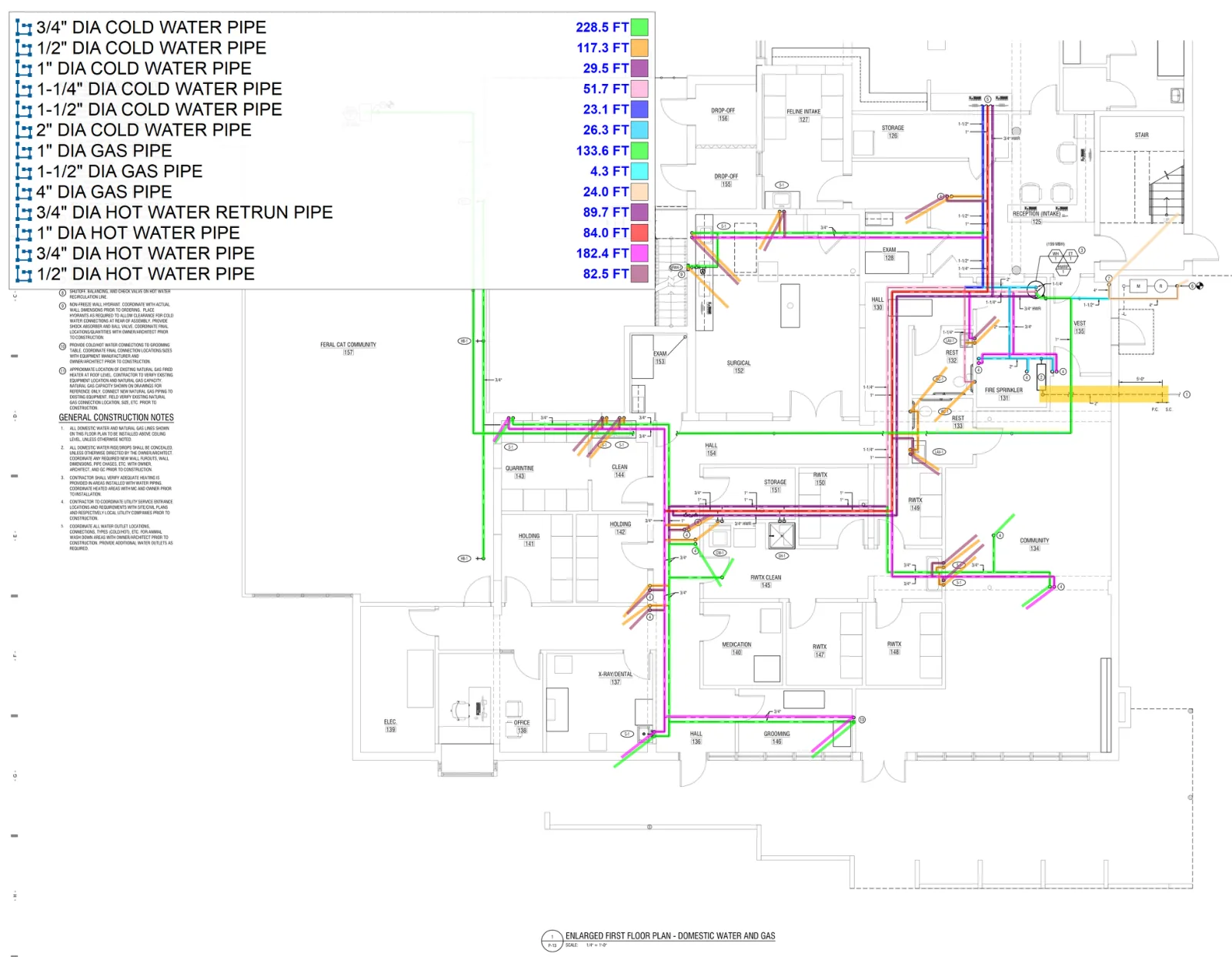
The drawings come back marked up in color, one color per material family, so any row traces back to the place on the plan it was measured from. That is the file you send to a vendor who disputes a count.

FILE THREE

The assumptions sheet

Written assumptions, inclusions and exclusions. Waste factors applied, stock lengths and sheet sizes assumed, yields taken for bagged material, anything the drawings left open and anything deliberately left out.

STRUCTURE

Your coding, not just ours

Grouped by CSI division as standard, or reordered to your vendor packages, phase codes, building and floor. Send your template with the plans and the list is delivered in it.

NEED IT PRICED

The same scope with labor and markup applied

A buy list leaves the money column empty on purpose. If you want the same scope priced with labor, equipment, burden and overhead and profit applied, that is the estimating side of the desk.

See construction estimating services
BEFORE YOU BUY

See a delivered package first

An anonymized buy list, formatted the way it would go to a vendor. Read down the waste column: it is its own line on every item rather than folded into the quantity above it. Send it to three suppliers and their quotes come back comparable line for line.

See sample deliverables
WHERE THIS SITS

One desk, not a separate vendor

Buy lists, measured scopes and priced estimates run off the same drawing set, with the same estimators and the same two-step check behind them.

See takeoff services
One fixed price for the whole list, agreed in writing before a single row is measured.Get my fixed quote
THE VENDOR LOOP

Sending the list out, and reading what comes back

The sheet is built so three suppliers price the same lines. What happens after you email it is where the saving actually shows up, so here is how the file is set up to survive the round trip.

01

The same file goes to every vendor

One tab per vendor package, one empty price column, and the size or spec that decides which SKU they pull already sitting on the row. Nobody is reading your plans and nobody is guessing at grade, gauge or rating. It goes out under your name; the sheet carries no branding of ours.
Day one of buyout
02

Quotes come back against line numbers, not against a total

Because every vendor priced the same rows in the same order, the comparison is arithmetic. Paste each quote into its own column and the low line shows up, not just the low bid. That is usually where a package splits between two suppliers instead of going whole to one.
As they arrive
03

Substitutions surface instead of hiding

A vendor pricing a different product has to name the row they changed, because the row already states the spec. An or-equal on one line and a full-spec price on another is the most common way two quotes quietly stop being comparable, and a stated spec column is what makes it visible in seconds rather than at delivery.
Where they happen
04

Gaps between vendors show up before the order, not after it

One supplier includes fasteners and another does not. One carries freight and another quotes ex-works. Rows nobody priced are the gaps, and on a shared sheet they are empty cells rather than an argument three weeks into framing. Restocking a surplus nobody chose to order costs the same either way.
Before the PO
05

The purchase order is a filter and a copy

Each row can carry your cost code, your vendor package and your phase, so raising an order means filtering the sheet and copying it rather than retyping it. What you have already bought stays flagged, so a reissue after a design change remeasures the affected rows and leaves the purchased ones alone.
Purchase order
Send the drawings and the vendor packages you buy in. The sheet is built to go out the day it lands.Get my buy list quoted
FAQ

Buyout questions, answered

The questions purchasing agents ask before they send a set. If yours is not here, ask it at upload and it gets answered before you pay anything.

Scope and coverage

Do you price the materials, or only quantify them?

Only quantify them. The pricing column ships empty so your vendors fill it. If you want the same scope priced with labor, equipment, burden and markup applied, that is quoted separately from the same drawings.

What is not on a material takeoff?

No labor hours, no equipment, no crew rates, no markup and no schedule. Material only, in purchase units, with waste stated. Consumables are included where the drawings support them and listed as exclusions where they do not.

How do you handle allowances and items marked by owner or by others?

They stay on the sheet but off your order. Owner-furnished, by-others and allowance items are listed with the mark and source, then excluded from the purchase quantity and repeated on the exclusions sheet.

Do you include attic stock, spares and mock-up material?

Yes, on their own lines, where the specification calls for them. Attic stock, spare cartons and mock-up quantities are never merged into the working quantity, because they are stored rather than installed.

Files you send us

Do you need the specifications as well as the drawings?

Send them if you have them. Drawings and schedules carry most of it, but specs settle grade, rating and finish, which decide the SKU a supplier pulls. Without specs, those calls go on the assumptions sheet.

Can you build a buy list from a scanned or photographed set?

Only if the scale holds. A scan that will not verify against a stated dimension comes back flagged, because a small scale error on a large set turns into pallets of material you did not order. Send what you have and you hear either way before you are billed.

Can you work from a model export instead of PDF drawings?

Yes, alongside the drawings rather than instead of them. An export saves counting, but the drawings still govern, so exported quantities are checked against the sheets before they reach the buy list.

We already have quantities. Can you convert those into a buy list without remeasuring?

Yes, where the quantities trace back to the drawings. Send the takeoff and the set together and the conversion runs against both: measured figures roll up by material and size, convert into purchase units and pick up a waste column. Where a quantity cannot be tied to a sheet it is flagged instead of converted, because a purchase order built on a number nobody can point at is the expensive kind of mistake.

Format and handover

Can the list be split by vendor package, phase or building?

Yes. Tell us how you buy and the roll-up follows it: one tab per vendor package, per phase, per building or per floor. Splitting at delivery costs less than splitting a finished sheet later.

Does the sheet carry freight, sales tax and delivery?

As their own rows, off the material lines, and only where you ask for them. Freight and tax move with the vendor and the jurisdiction rather than with the quantity, so folding either into a unit cost is what makes two quotes stop being comparable. Say at upload whether you want the columns and they ship empty for your vendors to fill.

Can deliveries be scheduled off this, or is it one order?

Tell us how the job is phased and the list comes back grouped to it, so the shell releases while the interiors are still being priced. Long-lead items carry their own flag in a sortable column, which is what decides what has to be ordered in week one rather than at the framing meeting.

Accuracy and changes

We have already bought part of the job and the design changed. Can you reissue?

Send the revised sheets and the affected rows are reissued rather than the whole list rebuilt. Revisions on unchanged scope are included and the delta is called out. Lines you have already purchased get flagged, not reordered.

What happens when two sheets disagree about the same material?

The conflict is written down instead of silently resolved. The row carries the quantity taken, and the assumptions sheet records both sheets, which one was used and why. The open questions ship with the delivery.

Pricing and engagement

Do you talk to our suppliers, or is that on us?

Either way. The sheet is built to go out under your name, and most contractors send it themselves. Vendor coordination is available if you would rather we chase the quotes, scoped and priced with the takeoff.

How is a material takeoff priced?

One fixed figure for the whole list, scoped from your drawings and agreed before a row is measured. Nothing is billed until you agree to it. Buying out more than a couple of jobs a month usually costs less on a flat monthly retainer than package by package.

Send the drawings, get the buy list

Upload the set, tell us the trades and your buyout date, and a fixed quote comes back in writing. Nothing is billed until you approve it.

Start your material takeoff
STEP 1 OF 2
What do you need?
Project type
When is your bid due?
Describe your scope
Under a minute · No account, no payment
Rather talk it through? Call +1 (510) 810-0346 or book a 15-minute scope call. Not ready? See a real anonymized package first.