Construction estimating services that hold up under review
A priced, bid-ready number built from your drawings: measured quantities, labor and material corrected to the ZIP code on the title block, burden, overhead and profit on rows you can open and change. Delivered 24-96 hours from an approved fixed quote, with every assumption written down.
Every package includes
- Editable Excel or CSV with quantity, unit, unit cost and extended total
- Color-coded PDF markups of the sheets each quantity came off
- Written assumptions, inclusions and exclusions with pricing sources
- Burden, general conditions and OH&P as separate rows you control
How the number gets built
This is the sequence a priced estimate runs through before it reaches you, and where every dollar in it comes from.
Scope, fixed quote, written approval
Measure the scope before pricing it
Attach a baseline unit cost
Correct the baseline to your ZIP code
Price your buyout, not ours
Stack labor, burden, general conditions and OH&P
Two-step QA, then write down what we assumed
Inside the cost build-up, line by line
Every row in the workbook is a stack, not a single figure. Here is what sits in each layer of a construction cost estimating services package, and what you are free to argue with.
Direct cost
The buckets that pay for work actually put in place.
Material
By unitPriced at the unit the trade buys in, with waste carried as a named factor rather than folded quietly into the quantity.
Unit cost at the job's ZIP code
Adjusted from the baseline to the market on the title block, with the source and pull date recorded.
Waste as a named factor
Stated per material so you can raise it, lower it, or take it out and see the effect.
Labor
By crew hourHours come from a crew and a production rate, then meet a wage scale for the jurisdiction. Neither half is assumed.
Rate by classification
The classification that does the task, union or non-union, named on the assumptions sheet.
Hours by production, not by guess
Daily output per crew drives the hours, so a schedule change moves the labor line honestly.
Equipment
By durationOwned and rented equipment priced by the time the activity actually needs it, with mobilization carried separately.
Owned against rented
Whichever you run, priced at your rate when you send one and at market when you do not.
Mobilization and standby
Broken out, because a phased site pays for the same machine to arrive twice.
Indirect cost and markup
The rows a reviewer goes looking for first, kept in the open.
General conditions
CSI 01Priced against the duration of the schedule rather than dropped in as a flat percentage of the job. Where no CPM exists yet, the duration behind this row is the one worth arguing about first.
Construction scheduling servicesSupervision and project staff
Headcount by month, so a schedule extension shows what it really costs you.
Temporary power, water and enclosure
Carried by duration and by season where winter protection is in the specs.
Labor burden
On laborCalculated into the labor row instead of sprinkled across the total as one convenient number.
Payroll taxes, workers comp and general liability
Set to your state and your carrier rates when you send them.
Small tools, consumables and supervision
Carried against the crews that use them rather than against the whole job.
Overhead and profit
Your numbersYou set the margin. We never set it for you, and we never bury it inside a unit cost.
Your margin, on your row
Home office overhead and profit carry the percentages you type in and recalculate live.
Subcontractor OH&P
Sits on its own row so a reviewer can see it rather than hunt for it.
Risk, time and what is not drawn yet
The three lines that decide whether a number survives a year of design.
Contingency
Stated openlyCarried as its own row with a written reason, never blended into unit costs where nobody can find it.
Design contingency
Sized to how much of the set is actually drawn, and reduced as documents develop.
Bid contingency
Held against known scope risk, listed so you can take it out before you submit.
Escalation
By monthCommodity movement between bid day and buyout, applied where the program is long enough to matter.
Commodity movement to buyout
Applied by month to award rather than as one round percentage on the total.
Quote validity windows
Supplier quotes carried with their expiry, and long-lead items flagged with the reserve they need.
Allowances
With a basisWhere the design has not landed, the number carries a written basis instead of a confident guess.
What the allowance assumes
Quality level, quantity and exclusions written out beside the figure.
How it converts to a measured line
The trigger is named, so when the sheet arrives the swap is one edit, not a rebuild.
Labor is the line that decides the bid
Material has a price list. Labor has a crew, a production rate and a jurisdiction, and getting it wrong is the fastest way to buy a job you cannot build.
Crew composition, not a blended man-hour
Each activity is priced with a crew: a foreman, journeymen, apprentices and the equipment they run. Daily output for that crew comes from production recorded across 7,500+ priced projects, so the hours track the way the work actually gets installed instead of a single averaged rate applied to everything.
Union and non-union rates
Both are carried, and the estimate is priced to whichever applies where the job gets built. The assumptions sheet names which basis was used, which classification does which task, and where fringes sit, so a reviewer in that market can check it against their own agreement in a minute.
Shift work, overtime and the learning curve
Compressed schedules, second shifts, night work and repetitive floors all move production, and pretending otherwise is how a tight bid turns into an argument in month four. Where the schedule forces a factor, it is applied on a visible row and named, rather than absorbed silently into the crew rate.
Burden calculated into the labor line
Payroll taxes, workers compensation, general liability, small tools and supervision are computed against the labor they belong to. That matters when you self-perform one trade and sub the rest, because a blanket percentage on the whole job overstates burden on subcontract dollars you never carry.
Every pricing input, and how current it is
A number is only as defensible as the source behind it. This is what feeds each part of the estimate, how it stays current, and which cells are yours to overwrite.
| Material unit cost | RSMeans and National Construction Estimator baseline | Enriched by a 7,500+ project dataset | Yes, send a supplier list |
|---|---|---|---|
| Labor rate | Union or non-union scale for the jurisdiction on the title block | Pulled at the ZIP code | Yes, send your own scale |
| Production rate | Crew output recorded across 7,500+ priced projects | Updated as projects close out | Yes, on request |
| Equipment | Owned and rental rates by duration | Priced against the activity that needs it | Yes |
| Labor burden | Payroll taxes, workers comp, general liability, small tools | Set to your state and carrier | Yes, your percentages |
| Sub quotes | Your subcontractor quotes where you hold them | Carried with the validity window | Yes |
Send one set and get a fixed price first
An estimator reads the drawings, then a fixed price and a delivery date come back in writing. Nothing is billed until you approve it.
An estimate for every stage, from concept to bid day
The number a lender needs at concept and the number you submit on bid day are different documents built to different tolerances. We build both, and the stages between them.
Conceptual and budget estimates
A program, a site plan or a schematic set. Go or no-go before design money is spent.
Square foot and assembly pricing
ConceptPriced at the level the documents can actually support, so the output reads as a decision tool rather than a bid.
A stated range, not a false decimal
A band with a low and a high, because a single figure at concept is a number nobody can defend.
Program areas and gross factors
Net to gross, circulation and back of house carried openly so the area basis is checkable.
What the range rests on
BasisThe comparables and the exclusions are written down at concept, which is when they matter most and get recorded least.
Comparable projects in the dataset
Drawn from priced work of similar type, market and size rather than a national per foot figure.
Written exclusions at concept
Everything the range does not cover, listed, so the owner reads a budget instead of a promise.
Schematic and design development estimates
Priced at 50% and 90% documents, with allowances where the design has not landed.
Allowances with a written basis
50% and 90%Each allowance says what it assumes, which is what turns an owner review into a decision rather than a debate.
What is assumed inside each allowance
Quality tier, quantity and the exclusions that sit behind the figure.
What would replace it with a measured line
The sheet or spec section that converts the allowance, named up front.
The delta against the last number
ReconciliationThe first question in every design development meeting is why the number moved, so the answer ships with the estimate.
Line by line reconciliation
Previous total, current total, and the rows that account for the difference.
Scope growth separated from price movement
Design creep and market escalation are shown apart, so the right conversation happens.
Hard bid and bid-day estimating
The number you submit, built to the form the owner published.
The number you submit
Bid dayThis is what most contractors mean when they go looking for bid estimating services: a full CSI 01-49 build-up with region-correct labor and material, burden, general conditions and OH&P.
Full CSI 01-49 build-up
Divisions carried whether or not you self-perform them, so scope gaps surface before buyout.
Delivery scheduled against your bid date
Inside the 24-96 hour window and confirmed in writing with the fixed quote.
Bid form compliance
FormsThe bid form shapes the workbook, not the other way around, so nothing gets retyped into the proposal at 4pm on bid day.
Unit price schedules
Built to the units and increments the form asks for, priced off the same build-up as the base bid.
Alternates in the owner's numbering
Add and deduct alternates carried in the owner's order with the delta against base shown.
Single-trade and self-perform estimates
One package instead of the whole job, priced exactly the same way.
The trades you self-perform
One tradeQuoted the same way as a full-scope package: a fixed figure from your actual drawings, approved in writing before work starts. A fabricator pricing Division 05 here usually needs the shop drawings once the award lands, and that is a separate desk.
Structural steel detailing servicesPriced to your crews
Your composition, your wage basis and your equipment where you send them.
Your production history over a book average
Send closed-out job data and the output rates get tuned to it.
Checking a sub quote line for line
CheckMany contractors order the trades they self-perform, leave the rest to sub quotes, then use the build-up to test those quotes.
Quote against an independent build-up
Quantity, unit and extended total compared so a low bid can be read for what it excludes.
Gaps between trade packages
Scope nobody has claimed gets listed rather than assumed into somebody else's number.
What a reviewer will ask, and how the file answers
The questions a reviewer will put to you, answered before the meeting starts.
How accurate is a construction cost estimate?
Ours land within 3-5% of actual costs. That band comes from three things: quantities measured off the drawings instead of assumed, unit costs corrected to the ZIP code the job gets built in, and a second estimator auditing the priced package before it ships. It is a record built across 7,500+ projects, not a guarantee.
What makes a priced estimate defensible?
A reviewer can trace any figure back to the sheet it came from. Every quantity points at a labeled markup, every unit cost carries a stated source and pull date, and the assumptions, inclusions and exclusions ship as a written sheet. You open the file in the meeting and show them, without calling us first.
Who checks the pricing before it reaches you?
Two people, always. The first pass is the estimator's own: quantities back against the drawings, unit costs back against the baseline they were pulled from. The second is an audit by an estimator who did not build it, checking that burden, OH&P and general conditions sit where the assumptions sheet says. Revisions on unchanged scope are included, so if you disagree with an assumption, say so and we rerun it.
What does a lender read that a GC does not?
A lender reads contingency, escalation and allowances, because that is where an underfunded project hides. A GC reads scope gaps between trade packages. Both are answered on the same file: contingency and escalation sit on their own rows, and every allowance carries a written basis rather than a comfortable round number.
What happens when the estimate lands over budget?
You get options instead of an apology. Priced alternates, add and deduct schedules and value engineering packages arrive with the delta against the base number and a note on what each change costs in schedule or performance, so the meeting is about trade-offs rather than about your estimate.
What if the number turns out to be wrong?
Point at the line. Every quantity names the markup and the sheet it came from and every unit cost names its source, so a disagreement becomes a specific one in about a minute instead of an argument about a total. If the error is ours we rerun it, and revisions on unchanged scope are included. What the estimate never does is cover scope the assumptions sheet said it excluded, which is exactly why that sheet is written before delivery rather than reconstructed after a dispute.
Ask about scope or coverage before you upload anything
Wage basis, sales tax treatment, which divisions a package carries. Put the question to an estimator and get a straight answer.
One commercial estimate, drawings to submitted number
A realistic walk-through so you can picture the deliverable before you order it. This is a composite of typical work, not a client project.
A general contractor sends 38 architectural, structural, civil and MEP sheets plus a project manual as one 22 MB PDF, names a bid date eleven days out, and asks for a full build-up on a 42,000 square foot single-story retail shell with a 6,000 square foot fit-out. The estimator reads the drawing index and the bid form before the plans, because the bid form decides the shape of the workbook. A fixed price and a delivery date go back in writing that morning, and the job starts on approval.
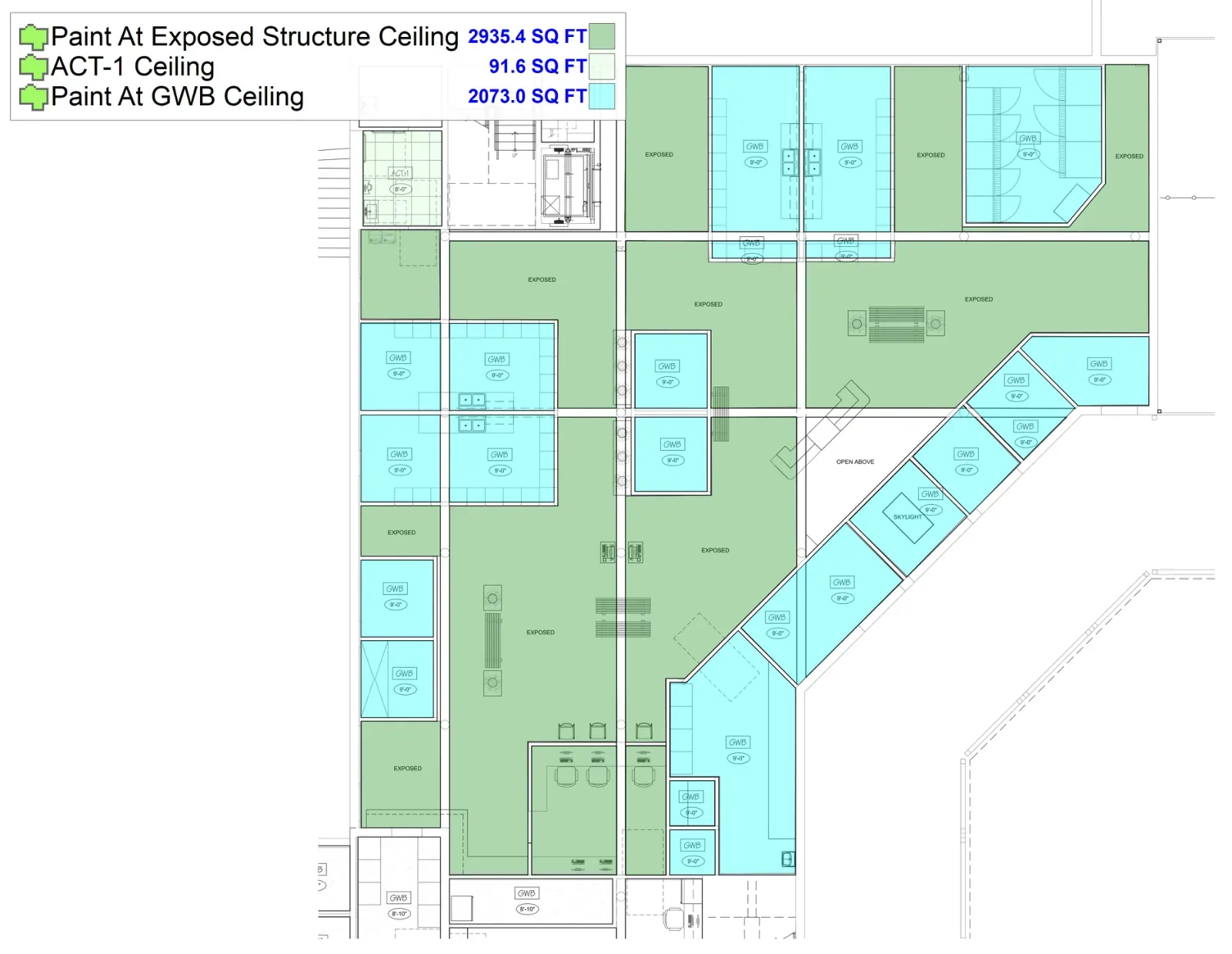
Measurement runs first. Footings and slab by cubic yard, formwork by contact area, rebar by ton off the schedules, structural steel by member weight against the framing plan, metal deck by square foot, CMU by block count from the elevations, storefront by linear foot with glazing by elevation, roofing by square, conduit by size and length off the power plan, ductwork by pound and linear foot. Every figure lands on a labeled markup, and the markups cover 26 of the 38 sheets.
Pricing follows. Baselines come off RSMeans and the National Construction Estimator, then move to the market on the title block. The contractor holds three sub quotes for roofing, fire protection and elevators, so those are carried at the quoted figure with the validity window recorded rather than repriced. Everything self-performed gets a crew, a daily output and a wage classification. Burden goes on the labor rows, not on the total.
Indirects land last. A seven month schedule drives general conditions by month: superintendent, project engineer, temporary power, dumpsters, safety and closeout. Overhead and profit carry the contractor's own percentages on their own rows. Contingency and escalation sit above them, visible and removable. The estimator self-checks, a second estimator audits the priced package, and the file goes out with 14 written assumptions and 9 exclusions attached.
What ships with a priced estimate
Three files, all editable, all traceable, plus the coding structure your cost system already expects.
The three files
Every package ships in the same three parts, in the format your cost codes expect.
The estimate workbook
Excel or CSVLine items by division with quantity, unit, unit cost and extended total. Crew rates and production sit behind the labor rows. Burden, general conditions and OH&P are rows of their own.
Unit price and alternate schedules
Built in the order the bid form asks for, so nothing is retyped into the proposal on bid day.
Open cells, no locked totals
Change a rate or a markup and the extended totals move in front of you.
Your template or CSI 01-49 coding
Send your template with the drawings and the workbook comes back inside it.
The marked-up drawings
Color-coded PDFEvery sheet a quantity came off, marked in color and keyed back to the workbook row. This is the file a reviewer asks for first.
Line to markup to sheet
Three steps from a number in the total to the place on the drawing it was measured.
Addenda tracked as they drop
Affected sheets remarked and the changed rows identified rather than silently overwritten.
The assumptions sheet
One pageWritten assumptions, inclusions and exclusions, plus every pricing source used and the date it was pulled. One page. It is what a lender or an owner asks for when they want to know why a line reads what it reads.
Inclusions and exclusions by division
What is carried, what is not, and which party the gap belongs to.
Pricing source and the date it was pulled
Baseline, market adjustment and any vendor quote named beside the row it priced.
Tooling and handover
How the build-up is authored, and what you keep afterwards.
Software the build-up runs in
Build-upBuild-ups run in PlanSwift, Bluebeam and Xactimate. Whatever the build-up is authored in, the deliverable is editable Excel or CSV, and source files are available on request.
Source files on request
Ask at the quote stage and the native files travel with the workbook at handover.
Getting the set to us
25 MBPDF or ZIP up to 25 MB through the form. Larger sets come in as a Drive, Dropbox or OneDrive link. Send the bid date with them.
NDA before a sheet changes hands
Signed on request before you upload anything, not after the estimate is delivered.
See a delivered package first
FreeA real priced estimate with the project name and address removed. Take any line in it and read across: the quantity, the crew, the production rate, the unit cost, the burden and the markup are all on the row. If a competitor's number will not open like that, you are being asked to trust a total.
See sample deliverablesCost estimating services by sector
A subdivision and a distribution center are priced by different rules. Here is which rule changes in each sector, and the page that goes into it properly.
Residential
Priced to the local market rather than a national average, with every allowance carrying a written basis so a selection upgrade reads as a delta instead of a surprise.
Residential construction estimating servicesCommercial
Compliance with the bid form decides whether your number gets read at all, so alternates, unit prices and addenda come back in the shape the owner's documents ask for.
Commercial construction estimating servicesIndustrial and heavy civil
Earthwork, structural steel and process scopes are priced in one pass, so nothing falls into the gap between two trade packages and surfaces at buyout.
Industrial and heavy civil estimatingPublic works
The agency's bid schedule sets the format, and a price that is not on their form in their pay items is non-responsive no matter how good the number is.
Public works estimating servicesInsurance restoration
A carrier prices from its own line-item list rather than a CSI build-up, so restoration scopes are written in Xactimate instead of built up by division.
Xactimate insurance estimatesWhich engagement fits your bid pipeline
One bid, a standing desk, or a named estimator. The work is identical in all three. What changes is capacity, continuity and cost per bid.
| Best for | Ad-hoc bids, trying us out | 3+ bids a month | Steady weekly volume |
|---|---|---|---|
| Pricing | Fixed price per project | Flat monthly retainer | Monthly, FTE-style |
| Delivery | 24-96h, scheduled to your bid date | 24-96h priority queue | 8 hours a day, 5 days a week |
| Quality check | Two-step QA | Two-step QA | Two-step QA, same estimator every job |
| Revisions | Included on unchanged scope | Unlimited, addenda included | Included on unchanged scope |
| Commitment | None, job by job | Month to month | Month to month |
| Typical saving vs in-house | ~25-35% | ~40-55% | ~35-45% |
| Addenda repriced as a delta | Quoted per addendum | Unlimited, included | Included |
| Your cost codes and templates | On request | Standing | Standing |
Three or more bids a month changes the arithmetic
The monthly partnership runs your queue at a flat retainer, with addenda repriced and revisions included. Tell us the bid volume and it gets sized.
What moves the price of the estimate itself
Every package is quoted from your actual drawings, so no price list would survive contact with a real set. What you can know before you send anything is which features of your job move the number, and which ones do not.
What moves it up
The four things that decide how many estimator hours a set takes.
Trade count, not sheet count
ScopeA 200 sheet set with one division ordered costs less than a 40 sheet set with every division on it. You are buying divisions, not paper.
Name the trades at upload
The quote covers those and nothing else, so scope you already have in house is never priced twice.
A full CSI 01-49 build-up
Carries every division whether or not you self-perform it, which is what makes scope gaps surface before buyout instead of at it.
How much the drawings actually resolve
DocumentsA 90% set with schedules, sections and a project manual prices faster than a 50% set where half the conditions need an allowance and a written basis.
Schedules and specifications included
Door, fixture, panel and finish schedules cut the reconciliation work and the number of open questions that have to be written up.
Allowances cost more than measurements
Every allowance carries a written basis and a named trigger. A measured line just needs the sheet it came off.
How deep the pricing goes
Build-upQuantities alone cost less than quantities priced. Priced against your own buyout costs more than priced off the baseline.
Measured only
Counts, lengths, areas and volumes with the markups, nothing priced. The cheaper order, and the right one if you hold your own rates.
Vendor coordination
Pricing material at your buyout means talking to your suppliers, which is arranged job by job and quoted with the package.
The shape of the output
FormatUnit price schedules, alternates in the owner's numbering and delivery inside your own template are built into the quote rather than added to it afterwards.
Your cost codes
Send the code list with the drawings and the mapping is part of the package, not a change to it.
What does not move it
Four things contractors expect to be charged for and are not.
Where the job is
All 50 statesPricing is pulled for the jurisdiction on the title block in every state. A job in a market we have not worked in is quoted the same way as one down the road.
Revisions on unchanged scope
IncludedDisagree with an assumption and ask for a rerun. Revisions on unchanged scope are included, so raising something costs you the message and nothing else.
The two-step check
StandardThe estimator self-check and the independent second-estimator audit run on a one-division package and on a full set. Neither is an upgrade you buy.
The quote
Before you owe anythingAn estimator reads the set and prices it before a dollar is billed. If the number or the date does not suit you, the quote expires and that is the end of it.
Picking the model, in plain arithmetic
Two questions that settle it faster than a proposal does.
When does per bid stop making sense?
Count the bids you walk away from because nobody had time to price them. At one or two a month, per bid is right: a fixed price quoted from your actual drawings, approved in writing, nothing billed until you approve it. At three or more a month the retainer costs less per bid than the per-bid rate, so that is usually where contractors land.
What does a dedicated estimator actually change?
Continuity. A named estimator from our bench works your queue 8 hours a day, 5 days a week, in your templates and your cost codes, so the person pricing job forty already knows how you carry general conditions. The two-step QA does not change, and neither does the 24-96 hour window on an individual package.
Cost estimating questions, answered
What contractors ask before they send a set over.
Scope and coverage
What the pricing carries
Accuracy and checking
Format and cost codes
Ordering and next steps
Get your number priced
in 24-96 hours from approval
Upload the drawing set, name the trades and give us the bid date. A fixed price and a delivery date come back in writing, and nothing is billed until you approve it.